
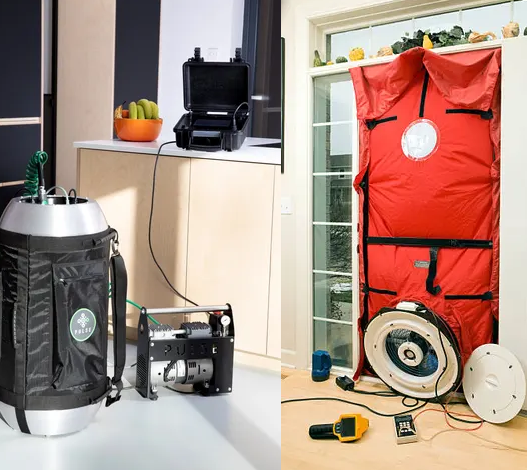
Comparison of Pulse and Blower Door Methods of Air Tightness Testing
Building Pressurisation with a Fan
The blower door method has been around for decades and inherently measures building airtightness at a high pressure of 50Pa using a traditional fan with a speed controller. This can exert unnecessary stresses on the building fabric depending on whether it is a pressurisation test or depressurisation test. Windows, doors and hatches etc will be forced closed creating a better seal (during depressurisation) but unrealistic conditions so a pressurisation test is also best practise in addition and an average of the two taken for the final result.
Building Pressurisation with Compressed Air
Pulse testing dynamically measures building air leakage at a much lower pressure differential of 4Pa. This is much more representative of “real world” conditions without exerting unnecessary pressure and stress on the fabric of a building. A Pulse test only requires a single pressurisation test that involves releasing a “pulse” of air and measuring the decay in building pressure over a few seconds.
Part L Building Regulation Compliance
Under the latest CIBSE TM23 guidance, a blower door fan test requires that both a pressurisation and depressurisation test are performed to mitigate the problems caused by testing at high pressure, increasing the time and cost it takes to test a building. However this is not compulsory.
Both the blower door and pulse methods are approved for new-build compliance testing and as long as the tester is part of a competent persons scheme.
Retrofit Opportunities
With SAP10 and rdSAP10 incoming a compliant air test result can be used to improve SAP ratings/ energy ratings.
With the goal of social housing to be SAP C by 2030 and all homes net-zero by 2050 this is a great opportunity for the Air Tightness Testing profession.
Pros and Cons of Pulse vs Blower Door Air Testing
Below we have formulated a table of the pros and cons for both methods – we hope you find it useful:
| Description | Pulse | Blower Door |
| Methodology | Compressed air – meaning once the cylinder is primed a test can be completed in seconds | Fan – meaning to build pressure takes longer (minutes rather than seconds) |
| Cost of Test per unit | >£45 | >£175 (however this does decrease with the number of tests carried out in a visit) |
| Part L Compliant | Yes | Yes |
| PAS2035 Compliant | Yes | Yes |
| CIBSE TM23 Compliant | Yes | Yes |
| Ability to carry out Background Ventilation Testing | Yes | No |
| Ability to carry out Air Leakage Diagnostic Testing | No | Yes |
| Can carry out pressurisation and depressurisation testing | No | Yes |
| Low Pressure | Yes | No |
| Simple Operation | Yes | No |
| Minimal Disruption | Yes | No |
| Equipment Manual Handling | No (compressed air can also be risky if stored during transit, bulky) | Yes (small systems can fit into a standard gun-case and duffle bag) |
| Overall Scores (Higher the better) | 7 | 6 |
Pulse Testing is the Winner
Pulse Testing, using our table of pros and cons, is the winner with a 1 point lead. However, in the real world it really comes down to the engineers preference and the intended outcomes of the testing.
Have a project in mind? Let’s get to work
We’re friendly and knowledgeable bunch so why not get in touch for a chat. You can always contact Building Compliance Testing with any questions through phone, email or our online chat service.
Don’t worry, we don’t charge for advice given over the phone, so why not ask for a free quote?
One thought on “Pulse vs Blower Door Air Testing Comparison”